Most budgeting apps that import your transactions don't talk to your bank themselves. A data company does it for them: Plaid, MX, Finicity (now part of Mastercard) or a bank-run network such as Akoya. You see a pop-up, pick your bank and approve. Behind it, that company collects data from your accounts and passes it to the app.
None of this is secret, but it is rarely spelled out on the screen where you tap Connect. Everything below about Plaid is quoted from Plaid's own pages, read on 6 October 2026. Other aggregators publish their own policies, and the same questions apply to them.
01Who is in the middle
Plaid describes its business plainly: "Plaid doesn't charge you for our services. When you connect your financial accounts to an app like Venmo or Oportun, the app pays us a fee to enable that connection." So there are three parties to every link: your bank, the aggregator and the app. Each has its own privacy policy, and the app's is only one of them.
- Plaid is the name most people see in the connection pop-up.
- Finicity runs Mastercard's open finance services in the US. Mastercard's developer documentation says its US open finance solutions "are provided by Finicity, a Mastercard company."
- Akoya calls itself "the only 100% API-connected, consumer permissioned data sharing network." When it launched in 2020, its announcement said it "eliminates the need for consumers to share account user ids and passwords."
- MX is another large aggregator that many banks and apps use.
02What the connection can read
Plaid's End User Privacy Policy (effective 8 December 2025) lists what it collects from the accounts you connect. Depending on the account type and what the app asks for, it includes:
| Kind of data | What Plaid's policy lists |
|---|---|
| Account data | Financial institution name, account name, account type, account ownership, branch number, IBAN, BIC, account number, routing number and sort code |
| Balances | Current and available balance |
| Transactions | Amount, date, payee, type, quantity, price, location, involved securities and a description of the transaction |
| Credit accounts | Due dates, balances owed, payment amounts and dates, transaction history, credit limit, repayment status and interest rate |
| Loan accounts | Due dates, repayment status, balances, payment amounts and dates, interest rate, guarantor, loan type, payment plan and terms |
| Investment accounts | Transaction information, type of asset, identifying details about the asset, quantity, price, fees and cost basis |
An app usually asks only for what it needs, and a budgeting app mostly wants transactions and balances. But the transaction history is the part that says the most about you: where you shop, how often, and how much. Plaid's policy also says: "We only share your personal financial data with third parties to power the services you requested, when you consent, and/or to protect against actual or potential fraud."
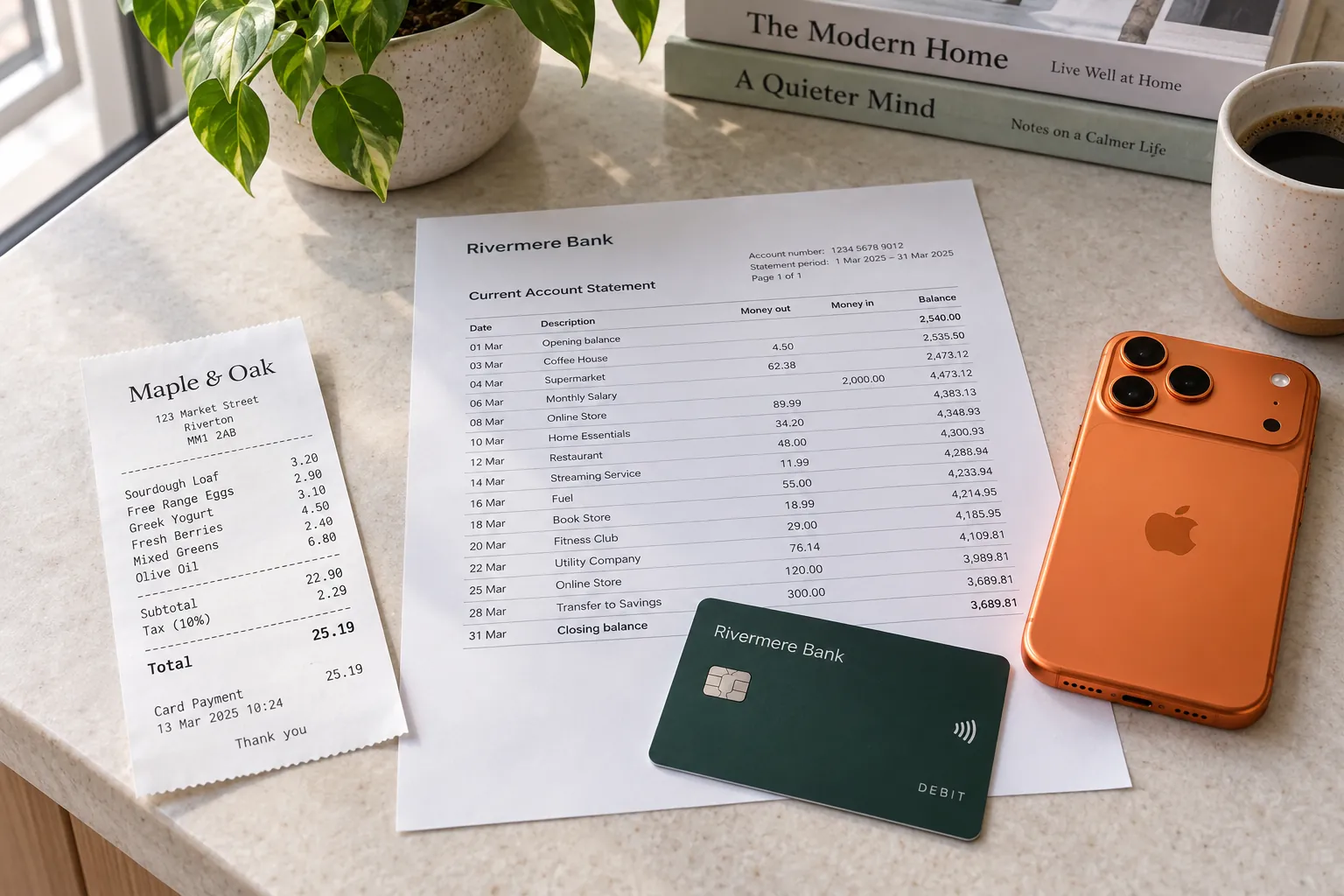
03Password or token: two ways to connect
There are two ways a connection can be made, and which one you get depends on your bank.
- You type your bank username and password into the aggregator's window. Plaid's consumer page describes this: "you will be prompted to enter the username and password associated with those accounts," and adds that "we don't share the username and password for your financial institution with your apps."
- You are sent to your bank's own login page instead, and the bank hands the aggregator a token. Plaid's documentation for banks describes the result: "Credentials stay with you. Tokens are scoped, revocable, and expire."
The second kind is better for you. Your password never leaves your bank, and the bank can see and end the connection. If the pop-up opens your bank's real website or app to log in, you are on the token path. If you type your bank password into a window that isn't your bank's, you are on the first path.
04How long the data stays
Plaid's policy gives no fixed number of days. It says: "We retain your data only as long as it is needed," and lists exceptions such as legal requirements, connections that are still active, and fraud prevention. In practice, a connection you never removed is a connection that is still active. Deleting the budgeting app from your phone does not end it.
05How to see and cut off a connection
- Unlink the bank inside the app first, usually under Settings or Accounts. Then delete your account in the app if you are done with it, because unlinking alone doesn't erase the history it already imported.
- For anything that went through Plaid, open Plaid Portal at my.plaid.com. Plaid says you can use it to "terminate the connection between apps and your financial accounts and delete associated data stored in Plaid's systems."
- Look in your bank's own security settings for a list of connected apps or third-party access, and remove anything you no longer use. Not every bank has one, and the names differ.
- Change your bank password if you ever typed it into an aggregator's window and have stopped using the app.
06Where the US rules stand
In October 2024 the Consumer Financial Protection Bureau finalized a Personal Financial Data Rights rule under section 1033 of the Dodd-Frank Act. Among other things, it was meant to move the market away from sharing bank passwords. It is not in force. On the CFPB's own pages, read on 6 October 2026, the rule's compliance dates are stayed by a federal court in Forcht Bank, N.A., et al. v. Consumer Financial Protection Bureau, and the Bureau has been reconsidering the rule since an advance notice of proposed rulemaking on 22 August 2025. No replacement rule appears on those pages yet.
So for now, how your data is handled depends mostly on the policies of the app and the aggregator you agreed to, which is a good reason to read both.
07What a bank feed can't tell you anyway
Here is the trade, seen from the other side. This is one shopping trip.
Fairway Pharmacy
Thu 1 Oct · 18:05
| Item | Category | Price |
|---|---|---|
| Allergy tablets 30 ctHealthcare | Healthcare | $12.49 |
| Vitamin D 90 ctHealthcare | Healthcare | $8.99 |
| Sunscreen SPF 50Personal Care | Personal Care | $10.79 |
| Sparkling water 12 pkFood & Dining | Food & Dining | $5.99 |
| Birthday cardGifts & Donations | Gifts & Donations | $4.50 |
- Subtotal
- $42.76
- Tax 7% on 15.29
- $1.07
- Total
- $43.83
Card
A linked bank feed sees one line: Fairway Pharmacy, $43.83, on 1 October. It can't tell the allergy tablets from the birthday card, so a budgeting app guesses one category for all of it. The receipt splits the same $43.83 into $21.48 of health products, $10.79 of personal care, $5.99 of food, $4.50 of gifts and $1.07 of tax.
That is the case for tracking from receipts instead of a bank link: more detail, and nothing connected to your bank at all. Sorayli's receipt scanner reads each line and suggests a category before anything is saved, and Sorayli has no bank connection of any kind. The cost is that you capture each purchase yourself. The guide on tracking expenses without linking your bank shows a weekly routine that keeps it to a few minutes.
08A checklist before you tap Connect
- Find out which aggregator the app uses. It is usually named in the pop-up or in the app's privacy policy.
- Check whether you are sent to your bank's own login. If not, decide whether you are comfortable typing your bank password somewhere else.
- Read what the app says about selling data and advertising. We read six policies in do budgeting apps sell your data?
- Connect only the accounts the app needs. A budget rarely needs your retirement account.
- Put a reminder in your calendar to review connections in Plaid Portal and your bank's settings once a year.
Does Plaid give the app my bank password?
Plaid says it doesn't: "we don't share the username and password for your financial institution with your apps." Where your bank sends you to its own login page, Plaid receives a token rather than your password.
How do I see which apps have access to my bank through Plaid?
Go to Plaid Portal at my.plaid.com. Plaid says you can see your connections there, end them and delete the data Plaid holds for them.
Does deleting the app stop it reading my bank?
No. Removing the app from your phone leaves the connection in place. Unlink the bank inside the app, delete your account there, and remove the connection in Plaid Portal or your bank's settings.
Is the CFPB's open banking rule in effect?
Not as of 6 October 2026. The CFPB's pages show the 2024 rule's compliance dates stayed by a federal court and the rule under reconsideration since August 2025.
- 1The categories of account, balance, transaction, credit, loan and investment data Plaid collects; it shares data only to power requested services, with consent, or against fraud; it retains data "only as long as it is needed"; Plaid Portal can end connections and delete data.Plaid End User Privacy Policy (effective 8 December 2025)read 2026-10-06
- 2Apps pay Plaid a fee for each connection; users are prompted for their username and password; Plaid doesn't share them with apps; Plaid Portal manages connections.Plaid, How Plaid works for consumersread 2026-10-06
- 3With OAuth, "Credentials stay with you. Tokens are scoped, revocable, and expire."Plaid Core Exchange documentation, Authentication overviewread 2026-10-06
- 4US open finance solutions are provided by Finicity, a Mastercard company.Mastercard Developers, Open Finance US API referenceread 2026-10-06
- 5Akoya describes itself as "the only 100% API-connected, consumer permissioned data sharing network."Akoya homepageread 2026-10-06
- 6Akoya "eliminates the need for consumers to share account user ids and passwords."The Clearing House, Financial Industry to Give Consumers More Control Over Their Data (20 February 2020)read 2026-10-06
- 7The Personal Financial Data Rights rule's compliance dates were stayed by the court in Forcht Bank, N.A., et al. v. CFPB; the CFPB issued an advance notice of proposed rulemaking on 22 August 2025.CFPB, Personal financial data rights (compliance resources) and Personal Financial Data Rights Reconsiderationread 2026-10-06