Most grocery budgets fail for a boring reason: the number was never yours. It came from a rule of thumb, a friend's household or a round figure that felt responsible. Then the first month runs over, the budget looks broken, and you stop checking it.
The fix is to start from what you already spend. Take your last two or three months, pull out the food, set a limit close to what you found, and correct it once you have a month of real data. It takes about an hour, and you need nothing but your receipts or your card statements.
01Start with your own last two or three months
One month is not enough. A birthday party, a week away or a big stock-up can move a single month by a hundred dollars. Three months smooths that out. Two will do if that is all you have.
Collect every place food money went in those months:
- Paper receipts you kept, and the digital copies many chains keep in their app or loyalty account.
- Your card and bank statements. Every supermarket, market, bakery and corner-store charge counts. Write down the date and amount.
- Cash. If you paid cash and kept no receipt, a rough note of what you spent beats leaving it out. The guide to tracking cash spending has a simple way to catch it.
- Restaurants, takeout, delivery apps and coffee. You will separate these next, but list them now so nothing hides.
If you have no records at all, don't guess. Track for one month first, then come back. How to start tracking your expenses walks through that first month.
02Separate groceries from everything else
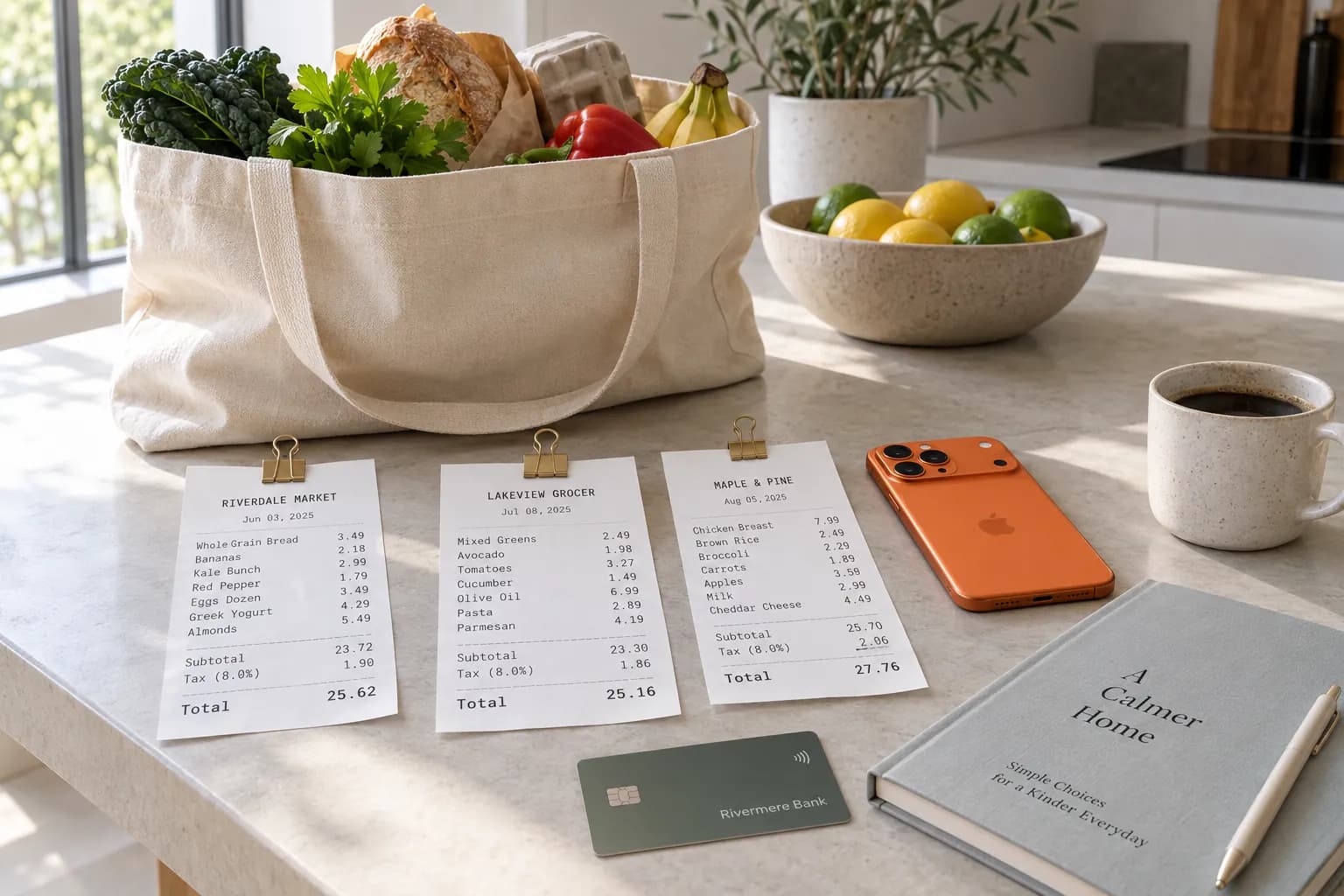
A statement shows one amount per store visit. The receipt shows what was in the cart, and a supermarket cart is rarely all food. Paper towels, dish soap, shampoo and pet food all come through the same checkout. If they stay in your grocery number, the number drifts every time you restock the bathroom, and you can't tell whether you ate more or simply bought a twelve-pack of toilet paper.
Draw three lines:
- Groceries: food and drink you bring home to prepare or eat.
- Household and personal care: cleaning supplies, paper goods, toiletries. Budget these on their own, or together with other shopping.
- Eating out: restaurants, takeout, delivery and coffee bought out. It is food, but it behaves differently, and mixing it in hides the most useful trade-off you have.
Here is one ordinary receipt split that way. If some of the abbreviations or weight lines on your own receipts are hard to follow, see how to read a grocery receipt.
Maple Street Market
Sun 9 Aug · 10:42
| Item | Category | Price |
|---|---|---|
| Whole milk, 1 galFood & Dining | Food & Dining | $3.89 |
| Large eggs, 12 ctFood & Dining | Food & Dining | $4.29 |
| Bananas2.30 lb @ 0.59/lbFood & Dining | Food & Dining | $1.36 |
| Chicken thighs2.10 lb @ 3.49/lbFood & Dining | Food & Dining | $7.33 |
| Penne pasta, 16 oz2 @ 1.79Food & Dining | Food & Dining | $3.58 |
| Frozen pizzaFood & Dining | Food & Dining | $6.99 |
| Coffee beans, 12 ozFood & Dining | Food & Dining | $9.49 |
| Paper towels, 6 pkHome | Home | $11.99 |
| Dish soapHome | Home | $3.49 |
| Toothpaste2 @ 3.29Personal Care | Personal Care | $6.58 |
- Subtotal
- $58.99
- Coupon, coffee beans
- -$1.00
- Sales tax 7% on 22.06
- $1.54
- Total
- $59.53
Card
The card statement says $59.53 at a grocery store. The food on it is $35.93: the seven grocery lines come to $36.93, minus the $1.00 coffee coupon. The other $23.60 is paper towels, dish soap, toothpaste and the tax on them. That is about 40% of the trip. If every visit looked like this and you budgeted from statements alone, your grocery figure would be about two-thirds too high.
03A worked example: three months to one number
Here is a two-person household's summer, split the way described above. All figures are an example.
| Month | Grocery store receipts | Household and personal care | Groceries | Eating out |
|---|---|---|---|---|
| June | $612.40 | $118.25 | $494.15 | $186.00 |
| July | $655.80 | $96.40 | $559.40 | $142.50 |
| August | $590.10 | $131.70 | $458.40 | $214.75 |
| Average | $619.43 | $115.45 | $503.98 | $181.08 |
Three things stand out. First, the store receipts average $619 a month, but groceries are $504. Budgeting $620 would have built in more than $100 of slack every month without anyone noticing. Second, July was the most expensive grocery month and the cheapest eating-out month. That is the trade-off you want to see, and it only shows when the two are kept apart. Third, household spend moves on its own schedule, from $96 to $132 a month depending on when the bulk paper goods were bought.
Example figures from the table above.
From here, pick the number. A simple rule: take your average, then decide whether you want to hold steady or cut. This household averaged $504 and had one month well above it, so they set $520. That covers an ordinary month with a little room and still asks for some care in a month like July. If you want to spend less, set the budget a modest step below your average, around 5 to 10%, rather than a dramatic one. A cut you keep is worth more than a big one you abandon in week three. For where the cuts can come from, saving money on groceries with your receipts goes line by line.
Set the eating-out number the same way, separately. Here the average is $181, so $180 to $200 would be honest.
04Check your number against the USDA food plans
Once you have your own figure, it helps to know where it sits. The US Department of Agriculture prices a healthy diet, with every meal made at home, at four budget levels and updates the cost every month from grocery prices. Thrifty is the plan SNAP benefits are based on. Low-cost and moderate-cost are where most households land. Liberal allows pricier choices.
| Household | Thrifty | Low-cost | Moderate-cost | Liberal |
|---|---|---|---|---|
| One adult (woman, 19–50) | $299 | $329 | $401 | $511 |
| One adult (man, 19–50) | $375 | $378 | $474 | $580 |
| Couple, 19–50 | $617 | $648 | $803 | $1,000 |
| Couple, 51–70 | $559 | $619 | $770 | $926 |
| Couple with children 2–3 and 4–5 | $914 | $939 | $1,155 | $1,425 |
| Couple with children 6–8 and 9–11 | $1,002 | $1,119 | $1,380 | $1,668 |
Read it as a range, not a target. The example household above spends about $504 a month on groceries for two adults; the USDA low-cost plan for a couple aged 19 to 50 is $648, so they are already below it. A figure far above the moderate-cost plan for your household usually means eating-out, household goods or pricey convenience food is mixed into the grocery number. Prices also vary a lot by region, and these are national averages.
05Weekly or monthly: match how you shop
A monthly budget suits people who shop in a mix of big and small trips, or who stock up at a warehouse store now and then. One large trip early in the month looks alarming in a weekly view and perfectly normal in a monthly one.
A weekly figure suits people who do one main shop a week, or who are paid weekly. It gives you a number to hold in your head at the register.
You can use both. To turn a monthly budget into a weekly one, multiply by 12 and divide by 52. For $520 a month that is exactly $120 a week. Don't divide by 4. A month is about 4.3 weeks, so dividing $520 by 4 gives $130 a week, and a month with five shopping weekends then costs $650. Even with the right weekly figure, the two views drift apart inside a single month: five weeks of $120 is $600, four weeks is $480. They agree over the year, so judge the weekly number week by week and the monthly number at month end.
| View | Amount | How it's worked out |
|---|---|---|
| Monthly | $520.00 | The budget you set |
| Weekly | $120.00 | $520 × 12 ÷ 52 |
| Halfway check (day 15 of a 30-day month) | About $260 | Half the monthly budget |
06Pick a check-in point before the month runs out
Finding out on the 31st that you went over teaches you something, but it saves nothing. Decide in advance when you want a warning. Try 80% of the budget: at $520, that is $416. If you hit $416 around day 24 of a 30-day month, you are on pace. If you hit it on day 17, the last two weeks need attention: plan meals from what is already in the cupboard, or accept the overspend knowingly.
A pen-and-paper version works fine. Write the budget at the top of a page, subtract each trip's grocery lines, and look at the remainder every Sunday.
07Adjust after the first month
Your first budget is a hypothesis. At the end of the month, compare what you spent on groceries with the limit and ask why they differ. Then change the number once, not every week.
- Over by a little, for a reason that won't repeat (guests, a holiday meal): keep the budget.
- Over by more than about 10%, for a reason that will repeat (prices went up, someone new eats at home): raise it to what you actually need. A budget you always break stops being information.
- Under by a lot: lower it next month, or keep it and move the difference somewhere on purpose. Unspent grocery money quietly becomes eating-out money if you don't decide.
- Groceries under but eating out over: the two are one food budget in practice. Look at them together before changing either.
After two or three rounds, the number usually settles. Fold the check into your monthly money review so it happens without a separate reminder.
08Setting it up in Sorayli
Sorayli has no bank connection, so a budget counts only the expenses you record by scanning a receipt or typing them in. That is also what makes the split above practical. When you scan a receipt with several items, each line gets a suggested category you can change before saving, and each line is saved as its own expense. File the paper towels under Home and they stay out of your grocery budget.
- New accounts start with Food & Dining but no separate Groceries category, so restaurant meals and supermarket food land in the same place. Add a Groceries category yourself, on the web or in the iPhone app, as a subcategory of Food & Dining if you like. Custom categories work on every plan.
- Create a monthly budget on Groceries. A budget counts only its exact category, so a budget on Food & Dining would not count expenses filed under Groceries. That also means a Food & Dining budget can serve as your eating-out budget once groceries have their own category.
- Set the alert threshold. It starts at 80% and goes from 50% to 100% in steps of 5%. When spending reaches it you get an email, plus a push on iPhone if you turn on push notifications, and a Budget exceeded alert follows at 100% of the limit.
- The Free plan keeps up to 2 budgets at a time, enough for Groceries and one for eating out, and includes 10 receipt scans a month. You can type expenses in as well.
Each month starts from zero and unspent money does not roll over. A budget you create on the 20th still counts what you spent from the 1st, so you can start today without waiting for next month. The details are on the page about budgets and spending alerts.
- 1Monthly cost of the low-cost, moderate-cost and liberal food plans by age and sex, and the household-size adjustmentsOfficial USDA Food Plans: Cost of Food at Home at Three Levels, U.S. Average, April 2026read 2026-10-06
- 2Monthly cost of the Thrifty Food Plan by age and sex, and its use as the basis for SNAP allotmentsOfficial USDA Thrifty Food Plan: U.S. Average, March 2026read 2026-10-06
How much should I spend on groceries a month?
There is no single right figure: household size, where you live and how you eat all move it. As a benchmark, the USDA low-cost plan for a couple aged 19 to 50 is $648 a month, and $1,119 for a couple with children aged 6 to 8 and 9 to 11. Start from your own average food spending over the last two or three months, then adjust after a month of tracking.
Should toilet paper and cleaning supplies be in my grocery budget?
It works better to keep them out. They are bought in bulk and irregularly, so they make your food number jump around. Give them their own budget or fold them into general shopping.
Is a weekly or monthly grocery budget better?
Monthly suits mixed or bulk shopping; weekly suits one main shop a week. To convert, multiply the monthly figure by 12 and divide by 52, not by 4.
What if I go over my grocery budget in the first month?
Expect it. Find out why, then change the budget once: keep it if the reason won't repeat, raise it if it will.