A grocery receipt is the most detailed spending record you get for free. Every line says what you bought, how many, and what you paid for each. Most of them go straight in the bin, which is a shame, because a month of them answers the question that generic advice can't: where does your grocery money actually go?
This method takes one evening and a month of receipts. You sort every line into a few buckets, list the things you buy again and again, check which discounts you got and which you missed, and compare shops on the items that matter. At the end you pick three changes and put a number on each.
01Gather four weeks of receipts
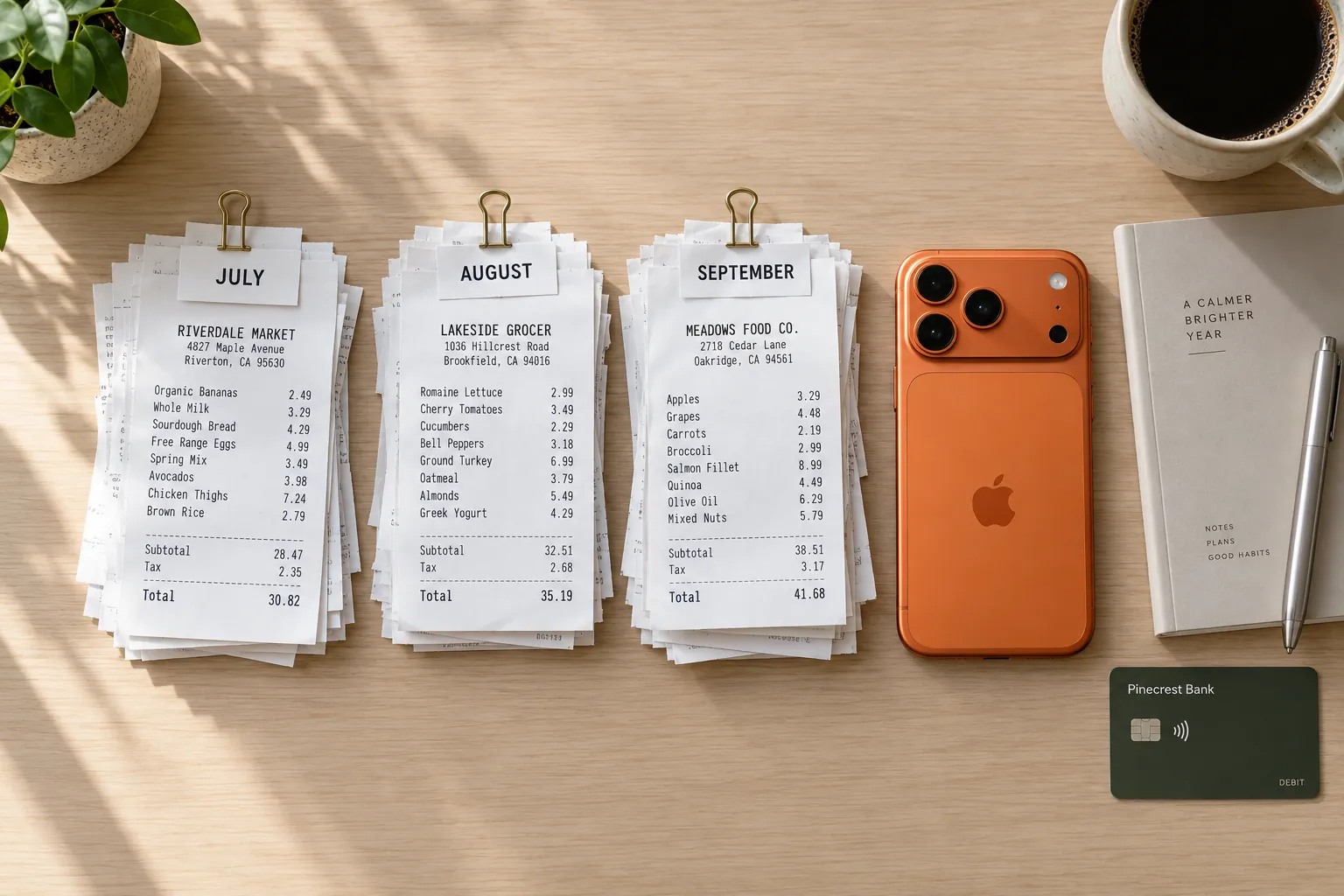
Four weeks is the minimum. It covers a full cycle of weekly shops, usually one bigger stock-up, and enough repeats to show a pattern. Two or three months is better if you already have them, since one party or one sick week can skew a single month.
- Include every shop, not only the main supermarket: the corner store, the bakery, snacks from the gas station, food bought at the pharmacy.
- If a shop keeps copies of your receipts in its app or loyalty account, download the ones you threw away.
- For a lost cash receipt, write the date, shop, total and the main items on a slip of paper. Rough is fine; missing is worse.
- Keep them in date order. If you need a system for this, organizing receipts covers paper and digital.
02Sort every line into your own buckets
A budgeting category like Food & Dining is correct but too coarse for this job. It lumps chicken thighs with frozen pizza and toothpaste. For this exercise, sort each line into five buckets of your own:
- Cooking basics: produce, meat, fish, eggs, dairy, bread.
- Ready-made food: frozen meals, deli counter, prepared salads and sandwiches.
- Snacks and drinks: chips, sweets, soda, sparkling water, alcohol.
- Pantry: coffee, tea, oil, rice, pasta, spices, canned goods.
- Non-food: cleaning products, paper goods, toiletries, pet supplies.
Use the line price before any discount, and deal with discounts separately in step four. If some lines are hard to decode, reading a grocery receipt explains the abbreviations, weights and tax codes. Here is one week's shop to work through:
Northside Grocer
Sat Sep 12 · 10:41
| Item | Category | Price |
|---|---|---|
| Bananas2.40 lb @ 0.65Food & Dining | Food & Dining | $1.56 |
| Greek yogurt 32 oz1 @ 5.99Food & Dining | Food & Dining | $5.99 |
| Chicken thighs3.00 lb @ 3.49Food & Dining | Food & Dining | $10.47 |
| Sharp cheddar 8 oz2 @ 3.79Food & Dining | Food & Dining | $7.58 |
| Potato chips2 @ 4.29Food & Dining | Food & Dining | $8.58 |
| Sparkling water 12 pk1 @ 6.49Food & Dining | Food & Dining | $6.49 |
| Frozen pizza2 @ 7.99Food & Dining | Food & Dining | $15.98 |
| Deli turkey sandwich1 @ 7.49Food & Dining | Food & Dining | $7.49 |
| Coffee beans 12 oz1 @ 11.99Food & Dining | Food & Dining | $11.99 |
| Toothpaste1 @ 4.49Personal Care | Personal Care | $4.49 |
- Subtotal
- $80.62
- Card savings, cheddar
- -$1.00
- Coupon, coffee
- -$2.00
- Tax 7% on 4.49
- $0.31
- Total
- $77.93
Debit card
Sorted into the five buckets, the same $80.62 of lines looks like this:
| Bucket | Lines | Amount |
|---|---|---|
| Cooking basics | Bananas, yogurt, chicken, cheddar | $25.60 |
| Ready-made food | Frozen pizza ×2, deli sandwich | $23.47 |
| Snacks and drinks | Chips ×2, sparkling water | $15.07 |
| Pantry | Coffee beans | $11.99 |
| Non-food | Toothpaste | $4.49 |
From the example receipt above. The five amounts add up to the $80.62 subtotal.
The finding here is the second bar. Ready-made food cost $23.47, almost as much as all the raw ingredients for cooking. That is 29% of the week's lines, and it was invisible on a receipt that simply said $77.93 at the bottom. Your own split will differ. The point is to find the bucket that surprises you.
03List what you buy again and again
Now go through all four weeks and write down every item that appears on two or more receipts. Next to each, note how many times you bought it and the price you paid. Multiply the two. Repeat items are where small savings compound, because any change you make repeats too: a dollar saved on something you buy every week is $52 over a year.
| Item | Times bought | Price each | Four-week cost |
|---|---|---|---|
| Frozen pizza | 6 | $7.99 | $47.94 |
| Sparkling water 12 pk | 4 | $6.49 | $25.96 |
| Coffee beans 12 oz | 2 | $11.99 | $23.98 |
| Greek yogurt 32 oz | 4 | $5.99 | $23.96 |
| Potato chips | 5 | $4.29 | $21.45 |
Sort the list by four-week cost, biggest first. The top three or four lines are your working list for the rest of this method. Ignore items you bought once; a one-off purchase is rarely where the money leaks.
04Check the discounts you got and the ones you missed
Add up the discount lines across the month: loyalty or card savings, coupons, multi-buy deals. On the example receipt that is $3.00 against an $80.62 subtotal. Writing the month's figure down tells you whether the loyalty card and coupon habit is worth the effort for you.
Then look for the discounts you didn't get. Your own receipts show them if you compare the same item at the same shop across weeks:
- The same item with a savings line one week and full price the next. That usually means a promotion that comes and goes. If it cycles, buy extra of the non-perishables on the discount weeks.
- A receipt with no card savings at all from a shop where you normally get some. That is often a forgotten card or app, and it is worth checking whether the shop will add the points or price afterwards.
- A multi-buy price you paid in full because you bought one fewer than the deal needed. Decide next time whether you would really use the extra one.
05Compare shops by unit price
Take the top items from your repeat list and compare them at the shops you already pass. Compare the price per unit, per ounce, per pound or per count, not per package, because pack sizes differ between shops and between weeks. If the shelf label shows a unit price, use it; otherwise divide the price on your receipt by the size.
In the example, the 12 oz coffee at $11.99 works out to about $1.00 an ounce. Suppose another shop sells a 32 oz bag for $24.99, about 78 cents an ounce. For the 24 ounces this household drinks in four weeks, that is roughly $5 a month. The sparkling water that costs $6.49 here is $4.99 at the other shop, so four packs a month save another $6.00.
- Only switch shops for items with a real gap. A second trip costs time and fuel, which can cancel a small saving.
- Buy a bigger pack only if you will use it before it goes stale or spoils.
- Check the size on every receipt. When a pack quietly shrinks at the same price, the unit price rises without the sticker changing. Tracking grocery price increases goes deeper on this.
06Pick three changes and check them next month
Go back to your biggest bucket and the top of your repeat list, and write down three specific changes, each with a monthly dollar figure. Vague goals like "eat out less" or "buy fewer snacks" are hard to check. For the household in the example, the three changes might be:
| Change | How the figure is worked out | Per month |
|---|---|---|
| Frozen pizza three times instead of six | 3 × $7.99 | $23.97 |
| Sparkling water from the other shop | 4 × ($6.49 − $4.99) | $6.00 |
| Coffee in the 32 oz bag | $23.98 − (24 oz × $24.99 ÷ 32) | $5.24 |
That adds up to about $35 a month, from habits the household chose rather than from a list of generic tips. Next month, repeat the same count with the new receipts and see which changes held. Once you know your real monthly spend, set a grocery budget from it rather than from a guess.
07Where Sorayli does the adding up
Everything above works with a pen and a notebook. The slow part is copying lines off paper. The Sorayli receipt scanner reads each line of a receipt with its quantity, unit price and line total, plus the tax, discounts and total, and suggests a category for each item that you can change before saving. The Free plan includes 10 scans a month, which covers a weekly shop with a few to spare.
- Savings, in the iPhone app, on every plan including Free: it adds up the whole-bill discounts on the receipts you scanned over the last 12 months, such as a coupon or loyalty credit printed after the items. It shows the total, a figure for each month, which shops gave you the most, and your 50 most recent discounted receipts with each discount as a share of the bill before it.
- The price tracker, on Pro and Family: a product is tracked once it appears on two receipts at least a week apart within the last 12 months. It shows how its price moved from the first of those receipts to the latest, which products are rising and falling, and, for a product you bought at more than one shop, which shop was cheapest at the latest price. The iPhone app has the full tracker; the web dashboard shows a summary.
Pro is $9.99 a month or $69.99 a year; Family is $17.99 a month or $129.99 a year for up to five people. Compare the plans.
Can keeping receipts really save money on groceries?
Receipts on their own save nothing. They show which items and habits cost the most, so the changes you make land where the money actually goes.
How many weeks of grocery receipts do I need?
Four weeks is enough to see what you buy repeatedly. Two or three months smooths out one-off events like a party or a big stock-up.
What is the best way to compare grocery prices between stores?
Compare only the items you buy often, and compare the price per ounce, pound or count rather than per package. Switch shops only where the gap is big enough to be worth the extra trip.
Does Sorayli track grocery prices on the free plan?
No. The price tracker is part of Pro and Family. The Free plan includes 10 receipt scans a month, each itemized line by line, and the iPhone app's Savings total of the whole-bill discounts on your scanned receipts.