01The short answer
Receipts fall into two groups. Some back up a number on your tax return: income, a deduction, a credit, a business expense. Those have a keep-until date set by your tax authority, and it runs for years. Everything else is an everyday receipt, kept for a return, a warranty claim or a check against your card statement.
02The official rules by country
| Country | Who it covers | Keep records for at least | Late or missing return |
|---|---|---|---|
| United States (IRS) | Anyone filing a federal return | 3 years in the standard case. A return filed early counts as filed on the due date. | No return filed: keep records indefinitely |
| United Kingdom (HMRC) | Self Assessment, not self-employed | 22 months after the end of the tax year the return is for | Return sent late: 15 months after you sent it |
| United Kingdom (HMRC) | Self-employed: sole traders and business partners | 5 years after the 31 January submission deadline for that tax year | Return sent more than 4 years after the deadline: 15 months after you send it |
| Canada (CRA) | Individuals and businesses | Six years | Return filed late: six years from the date you file it |
United States
The IRS says to keep records that support an item of income, deduction or credit on your return until the period of limitations runs out: "the period of time in which you can amend your tax return to claim a credit or refund, or the IRS can assess additional tax."
| Your situation | Keep records for |
|---|---|
| None of the cases below applies | 3 years |
| You file a claim for credit or refund after you file your return | 3 years from filing the original return, or 2 years from paying the tax, whichever is later |
| You left out income you should have reported, and it is more than 25% of the gross income shown on your return | 6 years |
| You claim a loss from worthless securities or a bad debt deduction | 7 years |
| You do not file a return, or you file a fraudulent one | Indefinitely |
| Employment tax records, if you employ people | At least 4 years after the tax becomes due or is paid, whichever is later |
| Records connected to property | Generally until the period of limitations expires for the year you dispose of the property |
The property row works differently from the rest. A receipt tied to a home follows the home, not the year you paid it. The IRS also says to check whether your insurance company or creditors need records longer than it does before you discard them.
United Kingdom
HMRC gives an example of each rule. Send your 2024 to 2025 Self Assessment return online by 31 January 2026 and, if you are not self-employed, keep your records until at least the end of January 2027. A sole trader who sent a 2022 to 2023 return online by 31 January 2024 keeps records until at least the end of January 2029.
HMRC also says there are no rules on how you keep records: "on paper, digitally or as part of a software program." It can charge a penalty if records are not accurate, complete and readable, which is the test a faded till receipt fails.
Canada
The CRA's page for individuals says to keep tax documents and records for at least six years, including any proof for deductions or credits you claimed and your notices of assessment. Its page for businesses is more exact: six years from the end of the last tax year the records relate to, or six years from the date you file a late return.
03Which receipts are tax records
The IRS wording gives a test that works anywhere: a record matters for tax when it supports "an item of income, deduction or credit" on your return. Ask of each receipt whether a number on your return depends on it.
- Business expenses, if you work for yourself. The receipts back up the expenses you claim. The guide for freelancers covers keeping them sorted through the year.
- Proof for a deduction or credit you claim, which the CRA names directly.
- Records connected to property you own, which in the US follow the property until the year you dispose of it.
- Everything else. The weekly shop or a dinner out usually supports no line on a return, so it goes in the everyday pile below.
04Everyday receipts: returns, warranties and statements
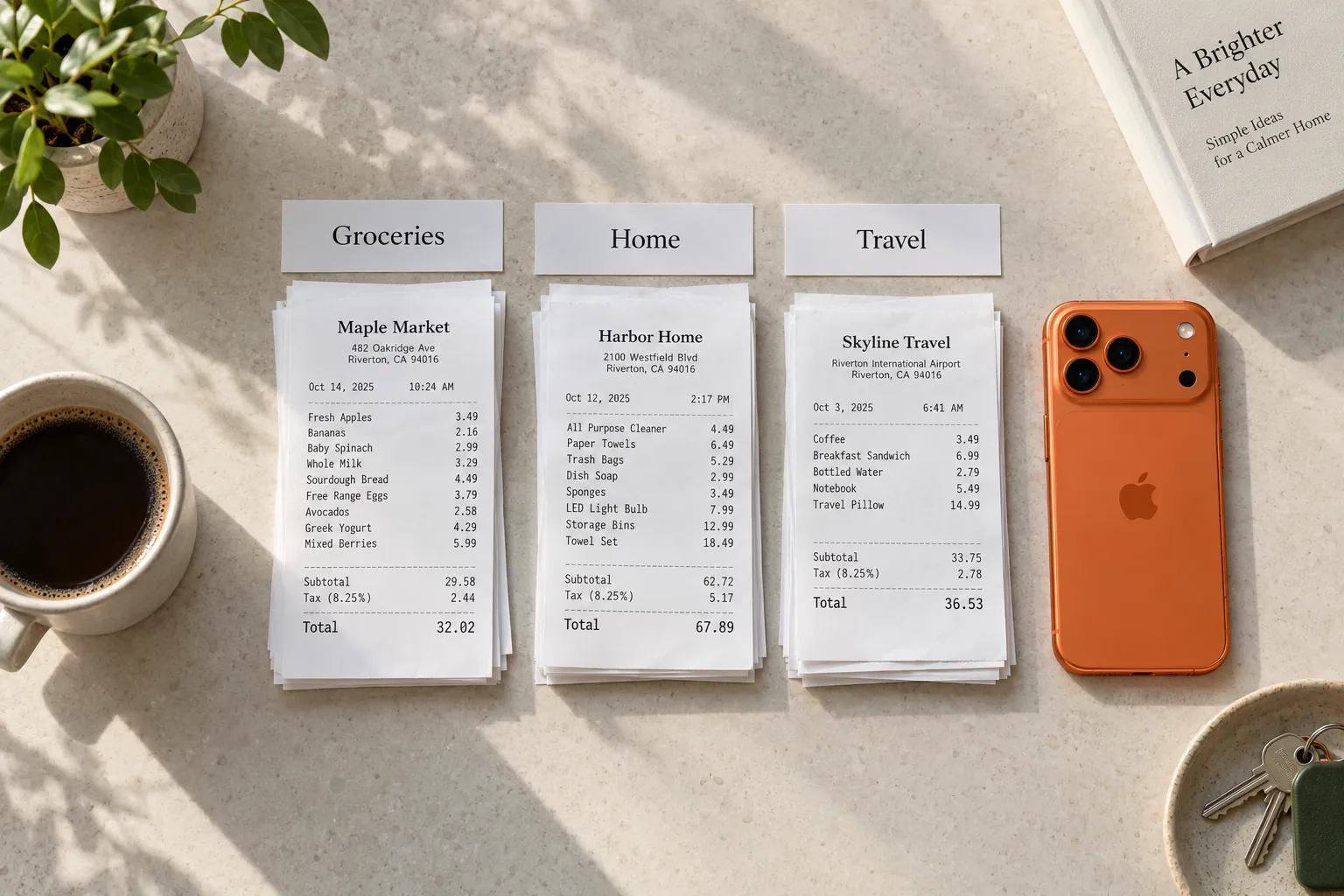
No tax rule covers most of what you buy, so the keep-until date is whichever of these ends last.
- The return window. The store sets it. It is often printed on the receipt itself, or posted in the store's own policy. Once it passes, the receipt has done that job.
- Your card statement. Keep the receipt until the charge shows up at the right amount. If you are charged twice, or charged the wrong amount, the receipt is your evidence.
- The warranty. Keep proof of purchase for as long as the warranty lasts. The length is in the product's paperwork or on the maker's site, and a claim will want to see when and where you bought it. Write the end date somewhere you will find it.
- Things you would insure. For electronics, furniture, tools and jewelry, the receipt shows what you owned and what it cost if something is stolen or damaged. Keep those for as long as you own the item.
One practical problem cuts across all four. Many till receipts are printed on heat-sensitive paper, and the print can fade in a warm car or a sunny drawer. For anything you need past a few months, a clear photo taken the day you buy is the safer copy.
05Working through one receipt
Here is the kind of receipt that causes trouble: household things and one possible business expense on the same slip of paper.
Maple Street Hardware
Sat 12 Sep · 10:41
| Item | Category | Price |
|---|---|---|
| Electric kettle 1.7 L1 @ 39.99Shopping | Shopping | $39.99 |
| AA batteries 8 pk2 @ 6.49Shopping | Shopping | $12.98 |
| Printer ink, black1 @ 24.99Shopping | Shopping | $24.99 |
| Extension cord 6 ft1 @ 14.99Shopping | Shopping | $14.99 |
- Subtotal
- $92.95
- Kettle coupon
- -$5.00
- Sales tax 8.00%
- $7.04
- Total
- $94.99
Visa
Say the buyer is a freelancer who claims printer ink as a business expense. Line by line:
- Printer ink, $24.99. A business expense, so it is a tax record. It follows the table above: 3 years in the standard US case, six years in Canada, and for a UK sole trader until at least 5 years after the 31 January deadline for that tax year.
- Electric kettle, $39.99 less the $5.00 coupon. A household item with a return window and a warranty. Keep proof of purchase until the warranty ends.
- Batteries and extension cord, $27.97 together. Once $94.99 shows up on the card statement and the return window closes, nothing depends on them.
In this example all four lines are filed under Shopping, because new accounts have no business category. If you work for yourself, add a Business category of your own (custom categories work on every plan) and move the ink line into it when you check the scan, so your business costs are easy to pull out at tax time.
You cannot tear the ink line off and file it separately, so the whole slip inherits the longest date on it: the ink's tax period. That is the practical case for a photo. The image goes in the tax-year folder, and the paper stops being the only copy of a record you may need for years.
06A sorting system that holds up
- Capture on the day. Photograph anything that might outlive its return window, before the ink fades.
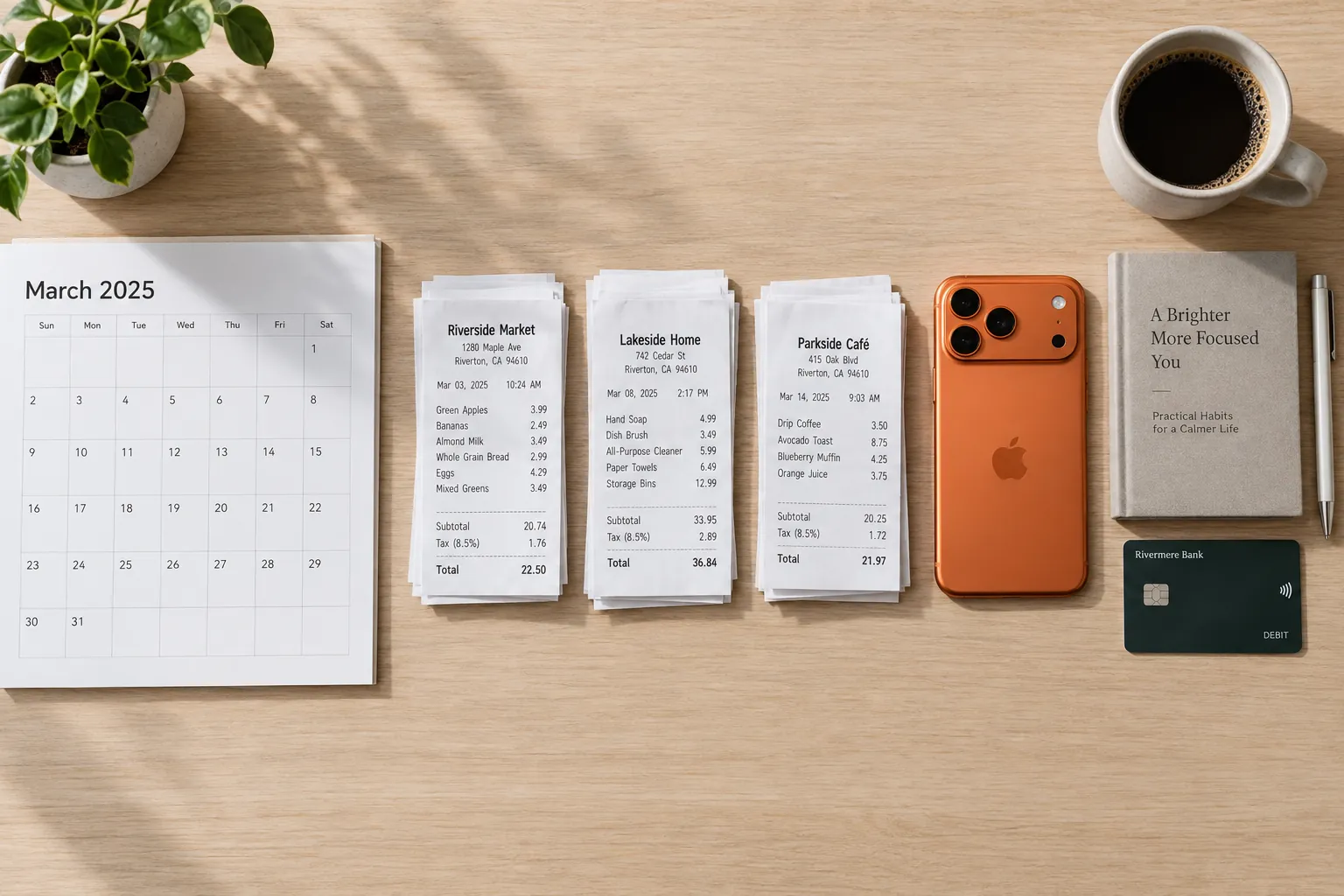
- Sort once a month into three groups: tax records, keep until a date (warranties and things you would insure), and check then toss.
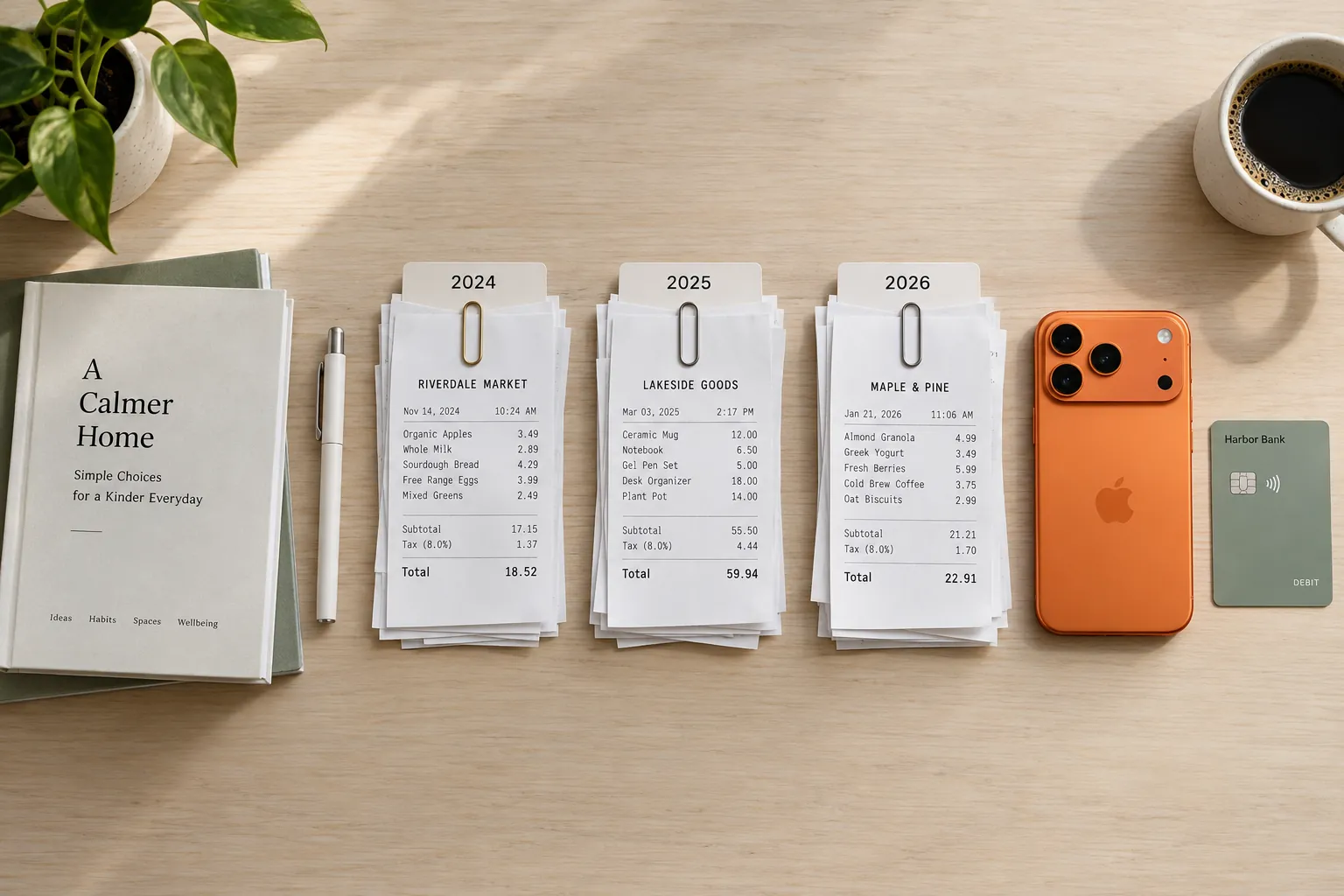
- File tax records by tax year. Every period above runs from a tax year or a return, so that is how you will look for them.
- Write the warranty end date on each warranty receipt, next to the product name.
- Check the statement, then toss the third group. A monthly money review is a natural place for this.
- Clear out once a year, working from your own country's page rather than memory.
For folders, labels and what to do with email receipts, see how to organize receipts.
07Where Sorayli fits, and where it stops
Sorayli covers the capture step. Take a photo of a receipt in the iPhone app, or upload one on the web, and it reads the shop, the date, each item with its price, the tax, discounts and total, and suggests a category for each item. You see the result and can fix any line before it is saved.
The photo is stored with your account and shows next to its transaction when you open it. When the kettle stops working, you find the purchase and the receipt is right there, printed date and all, even if the paper has faded blank.
Two limits matter for records you are required to keep:
- The web exports do not include the photos. On the web, Pro and Family can export transactions as CSV or account data as JSON, and the receipt images are not in those files.
- Deleting your account deletes your receipts and their images. It takes effect 30 days after you ask. Signing back in during that window cancels it, and after it the erasure is permanent.
So treat Sorayli as the place you find a receipt fast, not the only home for a record the law says to keep for years. Keep the paper, or your own copy, of anything in the tax group. The Free plan includes 10 scans a month; Pro and Family have no monthly scan limit, with fair-use caps.
How long should I keep receipts for taxes?
It depends on your country and situation. As of September 2026, the IRS says 3 years in the standard case, HMRC says 22 months after the end of the tax year (5 years after the 31 January deadline if you are self-employed), and the CRA says at least six years. Check your own country's rules.
Can I throw away a paper receipt if I have a photo of it?
HMRC says records can be kept on paper, digitally or in software. For other countries, check what your tax authority accepts before you discard an original you are required to keep.
How long should I keep a receipt for a warranty?
For as long as the warranty lasts. The length is in the product's paperwork or on the maker's site, so note the end date when you file the receipt.
Does Sorayli keep my receipt photos?
Yes. A scanned photo is stored with your account and shows next to its transaction. It is not included in the web exports, and deleting your account deletes it 30 days after you ask.
- 1US periods: 3 years standard; refund claim 3 years from filing or 2 from payment; 6 years if unreported income exceeds 25% of gross income shown; 7 years for worthless securities or bad debt; indefinitely if no return or a fraudulent one; employment tax at least 4 years; property until the period expires for the year of disposal; early returns treated as filed on the due date; check insurers and creditors before discarding.IRS, How long should I keep records? (last updated June 30, 2026)read 2026-09-28
- 2UK Self Assessment (not self-employed): at least 22 months after the end of the tax year; 15 months after sending a late return; the 2024 to 2025 example.GOV.UK, Keeping your pay and tax records: How long to keep your recordsread 2026-09-28
- 3UK: no rules on how you keep records (paper, digitally or software); penalty if records are not accurate, complete and readable.GOV.UK, Keeping your pay and tax records: Overviewread 2026-09-28
- 4UK self-employed: at least 5 years after the 31 January submission deadline; the 2022 to 2023 example; 15 months after sending a return more than 4 years late.GOV.UK, Business records if you're self-employed: How long to keep your recordsread 2026-09-28
- 5The self-employed rules apply to sole traders and partners in a business partnership.GOV.UK, Business records if you're self-employed: Overviewread 2026-09-28
- 6Canada, individuals: keep tax documents and records at least six years, including proof for deductions or credits claimed, returns and notices of assessment.Canada Revenue Agency, How long should you keep your income tax records? (modified January 20, 2026)read 2026-09-28
- 7Canada: six years from the end of the last tax year the records relate to; for a late return, six years from the date you file it.Canada Revenue Agency, Where to keep your records, for how long and how to request the permission to destroy them early (modified August 3, 2026)read 2026-09-28